- Home Page /
- Grocery & Gourmet Food /
- Dairy, Eggs & Plant-Based Alternatives /
- Dairy & Plant-Based Yogurt /
- Starter Cultures /
- Potato Dextrose Agar (PDA)
0 ratings

Item #:
3351159
Potato Dextrose Agar (PDA)
Item #:
3351159
BIF 125507
Price Details
Excluding Shipping & Custom charges ( Shipping and custom charges will be calculated on checkout )
*All items will import from US
0 ratings
Write a review
In stock
 Imported from USA store
QTY:
Order now and get it around Saturday, July 04
Secured transaction
Ubuy works hard to protect your security and privacy. Our advanced payment security system ensures confidentiality by encrypting your information during transmission using AES (Advanced Encryption Standards) and SSL (Secure Socket Layer) protocols. Your payment details are 100% secure as we do not share your payment details with third party sellers.
Our Top Logistics Partners


Frequently used in the expansion and isolation of mushroom mycelium.

Fast
Shipping

Free
Return*

Secure Packaging

100% Original Products

PCI DSS Compliance

ISO 27001 Certified


Note: Step Down Voltage Transformer required for using electronics products of US store (110-120). Recommended power converters Buy Now.


What Stands Out
Nutrient-Rich Formula
Potato Dextrose Agar provides a nutrient-rich environment that supports the growth of fungi and yeast, making it ideal for microbiological studies and applications.
Easy Preparation
This agar is designed for quick and straightforward preparation, allowing researchers to efficiently culture microorganisms without the complexity of other media.
Versatile Applications
Potato Dextrose Agar is widely used in laboratories for isolating and identifying fungi, making it a versatile tool for mycology, food safety, and clinical testing.
Product Details
| Item Weight | 1 lbs (450 grams) |
Who Should Buy?

-
Microbiologists
Ideal medium for growing fungi and yeast, facilitating various microbiological studies and research activities.
-
Food Industry
Useful in testing and monitoring yeast and mold contamination in food products, ensuring safety and compliance.
-
Education Purposes
Excellent for educational laboratories, providing students hands-on experience with fungal growth and microbiological techniques.

-
Bacterial Cultures
Not suitable for isolating most bacteria, as PDA is selective for fungal growth.
-
Antibiotic Testing
Inappropriate medium for antibiotic susceptibility testing due to lack of necessary nutrients for bacteria.
-
Clinical Diagnostics
Limited use in clinical labs for diagnosing bacterial infections, which typically require different culture media.
Product Description
Potato Dextrose Agar (PDA)
Have any Query? Chat with us
Customer Questions & Answers
-
Question:
What is Potato Dextrose Agar (PDA) used for?
Answer: Potato Dextrose Agar is primarily used for the cultivation of fungi and yeast. This nutrient-rich medium is particularly effective for encouraging the growth of molds, as its composition includes potato extract and dextrose, which provide essential nutrients. PDA is widely utilized in microbiology labs for isolating organisms from various sources, such as food and soil. Additionally, it is useful in studies related to fungal identification and metabolism. -
Question:
How do you prepare Potato Dextrose Agar?
Answer: To prepare Potato Dextrose Agar, you need to combine potato infusion, agar, and dextrose. Begin by boiling peeled potatoes in water to create a potato infusion. Strain the mixture to obtain the liquid and measure it. Then mix this infusion with the appropriate amounts of agar and dextrose, heat the mixture until it dissolves completely, and pour it into sterile Petri dishes. Allow it to solidify at room temperature before use. This method ensures a nutrient-rich medium suitable for fungal growth. -
Question:
Is Potato Dextrose Agar suitable for all types of fungi?
Answer: While Potato Dextrose Agar is well-suited for many fungi, some species may require specific growth media tailored to their unique nutritional needs. PDA is excellent for many molds and yeasts, particularly those in the genera Aspergillus and Penicillium. However, for specialized strains or specific studies, supplementing PDA with additional nutrients or adjusting pH may enhance growth and yield more accurate results in your research. -
Question:
Can I store Potato Dextrose Agar for later use?
Answer: Yes, Potato Dextrose Agar can be stored for later use, but it's crucial to do so correctly to maintain its efficacy. Once the agar plates are prepared and solidified, store them in a cool, dry place, ideally in a refrigerator. It's advisable to wrap the plates in an airtight seal or place them in a sealed container to prevent contamination. When ready to use, check for any signs of moisture or contamination before inoculating the agar. -
Question:
What organisms can be isolated using Potato Dextrose Agar?
Answer: Potato Dextrose Agar is excellent for isolating a variety of fungi, especially yeasts and mold. Common organisms include Saccharomyces cerevisiae (brewer's yeast), Candida species, and various Aspergillus and Penicillium species. Users often employ PDA in food microbiology to determine spoilage organisms in food products or assess yeast activity during fermentation processes in brewing and baking, making it an incredibly versatile medium. -
Question:
How can I increase the selectivity of Potato Dextrose Agar?
Answer: To enhance selectivity when using Potato Dextrose Agar, you can modify the medium by adding specific antibiotics or adjust the pH. For instance, introducing chloramphenicol can inhibit bacterial growth while allowing fungi and yeast to thrive. Additionally, altering the pH to be slightly more acidic may benefit fungal growth while keeping bacteria at bay. Such modifications are crucial for obtaining pure cultures from mixed samples in various microbiological applications. -
Question:
What are the best practices for inoculating Potato Dextrose Agar?
Answer: When inoculating Potato Dextrose Agar, it's vital to use sterile techniques to prevent contamination. Begin by sterilizing your inoculating loop or needle in a flame, then let it cool before touching the sample. Gently streak the loop across the surface of the agar in a zigzag pattern to evenly distribute the organisms. Repeat this process for different samples if needed, ensuring each is properly labeled. This method maximizes growth and provides clearer colony isolation for analysis. -
Question:
Is Potato Dextrose Agar suitable for food testing?
Answer: Yes, Potato Dextrose Agar is often employed for food testing, particularly in detecting spoilage organisms. Its nutrient composition supports the growth of molds and yeasts commonly found in food products. The agar helps in evaluating microbial quality in various foods, especially those prone to fungal contamination. When used in food microbiology labs, PDA can assist in monitoring and controlling spoilage organisms during processing and storage. -
Question:
How can I differentiate between fungal colonies on Potato Dextrose Agar?
Answer: Differentiating between fungal colonies on Potato Dextrose Agar involves observing various characteristics such as color, texture, and growth patterns. Each fungal species typically exhibits specific colony morphology; for example, Aspergillus may show a fuzzy green appearance, while Penicillium colonies are generally blue or green and have a powdery texture. Proper identification may require additional biochemical tests or microscopic examination to ascertain specific species, aiding in accurate microbiological analysis. -
Question:
Where can I buy Potato Dextrose Agar PDA in Burundi?
Answer: You can purchase Potato Dextrose Agar PDA through Ubuy in Burundi. Ubuy provides a wide range of laboratory supplies and equipment, ensuring you have access to high-quality PDA for your microbiological needs. Their user-friendly platform makes it easy to find and order the products you require for research or experimental processes. Check their website for availability and product details to ensure you get the right specifications.
Out-Grow Starter Cultures Editorial Review
The Potato Dextrose Agar (PDA) is a convenient and easy-to-use product, making it ideal for novice mycology hobbyists. However, some customers have experienced issues with clumping and difficulties in dissolving the agar powder. It is recommended to use cold water before adding it to simmering hot water to avoid clumps. Despite this, many customers have found success using the PDA for culture slants and have had no issues with sterilization. Overall, PDA is a great option for those looking for instant agar with close-to-ideal conditions.
Customer Reviews & Ratings
1 customers ratings
-
5 Star
100%
-
4 Star
0%
-
3 Star
0%
-
2 Star
0%
-
1 Star
0%
Review this product
Share your thoughts with other customers
Pros
- Easy to use for novice mycology hobbyists
- Ideal for making culture slants
- Convenient and saves time compared to making agar from scratch
- No issues with sterilization
Cons
- Clumping of agar powder
Product Price History
Important information
- Limitations : For products shipped internationally, please note that any manufacturer warranty may not be valid; manufacturer service options may not be available; product manuals, instructions, and safety warnings may not be in destination country languages; the products (and accompanying materials) may not be designed in accordance with destination country standards, specifications, and labeling requirements; and the products may not conform to destination country voltage and other electrical standards (requiring use of an adapter or converter if appropriate). The recipient is responsible for assuring that the product can be lawfully imported to the destination country. When ordering from Ubuy or its affiliates, the recipient is the importer of record and must comply with all laws and regulations of the destination country.
- Not all the products listed on Ubuy are for sale, as Ubuy is a global search engine. Products are subject to export/trade regulations.
BIF 125507
Order now and get it around Saturday, July 04
This item is not restrict in my country.(Please click on above link if this item is not restrict in your country, So our team will review and allow.)
QTY:
Secured transaction
Ubuy works hard to protect your security and privacy. Our advanced payment security system ensures confidentiality by encrypting your information during transmission using AES (Advanced Encryption Standards) and SSL (Secure Socket Layer) protocols. Your payment details are 100% secure as we do not share your payment details with third party sellers.
Our Top Logistics Partners
Fastest cross-border delivery
Features & Benefits
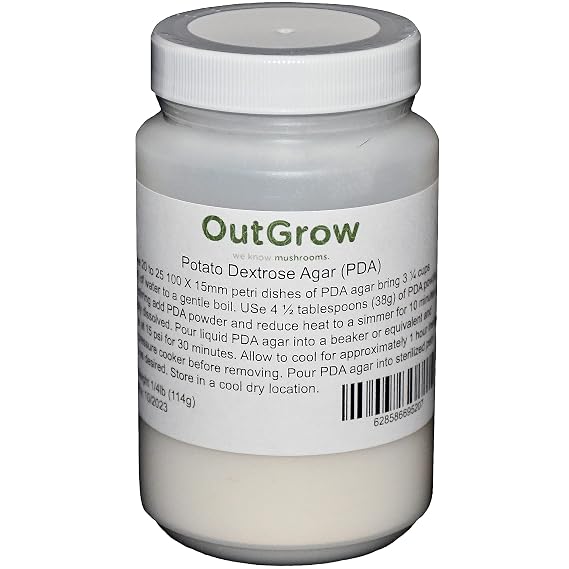
- Dry potato dextrose agar mix.
- 114 grams (1/4 lbs) per container.
- 20 grams per 500 ml of water to fill (20) 100 X 15 petri dishes.
- Heat water to a simmer and add potato dextrose agar mix.
- Sterilize at 10 psi for 30 minutes and pour.